Natural Bedding · Materials Guide
Choosing a Wool Comforter by Weight, Climate, and Care Needs
A wool comforter is more than a layer of insulation. Its fill weight, quilting, cover fabric, and care requirements all help determine how it feels through the night—and how it fits into a household’s routines. The right choice starts not with a season label, but with the temperature of your bedroom, your own sense of warmth, and the kind of maintenance you are prepared to do.
Wool’s appeal is rooted in the properties of the fiber itself. It can absorb moisture vapor, allow air to move through a textile, and provide insulation without feeling like a rigid blanket. But “wool comforter” is not a single construction or care category. Some are designed for light coverage, some contain a denser layer of batting, and others use washable blends or specific quilted structures. Comparing those details gives a clearer picture than relying on a product name alone.
Start with the room, not the calendar
Comforter weight is often described in seasonal shorthand: lightweight for summer, medium-weight for colder nights, or all-season for use throughout the year. Those labels can be useful, but they are not universal standards. A “light” comforter from one maker may not contain the same amount of wool as a light option from another. Room temperature, bedding layers, and the sleeper’s own preferences matter just as much.
Think first about the environment where the comforter will be used. A well-heated bedroom in a cold region can feel warmer at night than a drafty room in a mild climate. The number of blankets already on the bed, whether the sleeper shares warmth with another person, and whether the bedroom temperature changes overnight all affect how much insulation feels comfortable.
For a practical starting point, observe your current bedding. Do you regularly kick off the duvet, or reach for an extra blanket before dawn? Do you sleep comfortably under one moderate layer, or prefer a substantial, enveloping feel? These everyday clues can be more reliable than choosing a weight based on the month or an assumed climate category.
- Warm rooms or warm sleepers: Begin by comparing lightweight options and check whether the manufacturer gives fill weight or grams per square metre.
- Cool rooms or sleepers who prefer extra coverage: Consider medium-weight or heavier constructions, while accounting for sheets and blankets already in use.
- Rooms with large temperature swings: A moderate weight may be more flexible than a very light or very heavy comforter, especially when paired with an adjustable duvet cover or removable blanket.
- Shared beds: Consider whether both sleepers have similar warmth preferences. Separate blankets or a layered setup may work better than expecting one comforter to suit everyone.
These are starting points, not guarantees. People experience warmth differently, and comfort can also be influenced by pajamas, bedding construction, and room airflow. If possible, compare manufacturer specifications and return policies before treating a seasonal label as a promise of how a comforter will feel.
What fill weight tells you—and what it leaves out
Fill weight describes how much filling is used in a product or a given area. In comforter descriptions, it may appear as a total weight, an amount per square yard, or a figure in grams per square metre (GSM). This information offers a useful point of comparison, especially when products use the same general construction. A listing that provides no fill information gives you less to work with than one that clearly states its specifications.
Still, fill weight is not a complete warmth rating. The comforter’s dimensions, wool preparation, quilting pattern, outer fabric, and the way the filling is distributed all influence how it behaves. A densely quilted design can feel different from a looser, loftier one even if the two use comparable amounts of wool. Shell fabric also plays a role: a closely woven cotton cover and a lighter, more open-feeling shell may create different sensations against the body.
Wool itself is not one uniform material. Fiber characteristics vary with the wool source and processing, and comforter makers may use batting, layered wool, or a blend. These terms describe construction details worth investigating rather than a simple ranking from best to worst. A product made with wool batting may have its fill secured across the comforter, while another design may use a different arrangement or add other fibers.
When comparing products, look for the same group of details each time:
- Fill composition, including whether the comforter is wool-only or a blend.
- Fill quantity and the unit used to report it.
- Comforter dimensions and available sizes.
- Shell material and whether it is quilted or otherwise secured to the fill.
- Whether the design is intended for a duvet cover or can be used directly with a sheet.
- Care instructions, including any limits on washing, drying, or exposure to heat.
Two product pages that use the same phrase—such as “lightweight”—may still describe different amounts of fill or different materials. Treat the label as a broad guide, then use the construction details to make a more informed comparison.
Lightweight, medium-weight, or all-season?
Lightweight comforters
A lightweight wool comforter can suit people who prefer modest coverage, sleep in a warm room, or already use several other layers. Some products specify a lower fill amount per square yard or per square metre. For example, Sleep and Beyond describes its myComforter Light as a lighter option with a stated wool fill of five ounces per square yard, while its myMerino light comforter listing gives a fill amount of six ounces per square yard. Those figures are product-specific specifications, not a universal definition of “lightweight,” and they should be compared alongside dimensions and construction.
Light coverage can also be useful when seasons change gradually. Rather than storing a thick comforter for much of the year, some households prefer a lighter layer that can be supplemented with a blanket on colder nights. That approach gives sleepers more control, though it may be less convenient for people who want one finished bed layer without additions.
Medium-weight comforters
Medium-weight designs sit between lighter summer-oriented options and heavier cold-weather choices. They may suit bedrooms that remain moderately cool, or sleepers who prefer more coverage without the weight of a substantial winter comforter. A medium weight can be a practical compromise for a household that experiences seasonal shifts but does not want to rotate bedding frequently.
It is still important to check the maker’s stated fill amount. The label “medium” may express a brand’s own product range rather than a shared industry measure. One maker’s medium-weight wool comforter could have a different construction from another’s. Compare actual quantities where available, and ask whether the description refers to fill density, total fill, or simply a product grouping.
Heavier or all-season options
A heavier comforter may suit a cool bedroom or someone who enjoys a fuller, more substantial layer. But greater fill does not automatically mean a better night’s rest. A comforter that feels too warm can be uncomfortable, even if it is well made. The term “all-season” is also best understood as a broad design intention, not a guarantee that one weight will be ideal in every home, climate, or month.
Some households achieve year-round flexibility by adjusting the rest of the bed rather than asking the comforter to do all the work. A removable duvet cover can provide a washable outer layer; a blanket can be added when temperatures fall; and lighter sheets may feel more comfortable during warmer periods. The most versatile arrangement is the one that matches the room and can be changed without difficulty.
Climate is local—even indoors
Broad climate descriptions can hide important differences. A home in a cold region may have efficient heating and a consistently warm bedroom, while a house in a temperate area may have a chilly room with limited insulation. Coastal humidity, dry interior air, window placement, ventilation, and overnight heating habits can all shape the sleeping environment.
Wool is often chosen because it combines insulation with moisture-handling characteristics. The fiber can take up water vapor, and breathable bedding may help prevent a bed from feeling sealed or stuffy. That does not mean a wool comforter regulates a person’s body temperature in a precise or medical sense, nor does it guarantee that every sleeper will feel cool. Perceived comfort depends on the whole sleep setup and the individual using it.
For a bedroom that stays warm through the night, begin with a lower-fill option and avoid piling on layers before you know how it feels. In a room that cools significantly, consider a denser comforter or a layering plan that can be adjusted. If the temperature varies sharply between early evening and morning, removable layers may offer more flexibility than choosing a very heavy comforter as the sole solution.
Climate also affects care and storage. A comforter that is difficult to dry thoroughly may be less convenient in a damp household or a home without access to outdoor airing space. A product that is spot-clean only can still be manageable when protected with a duvet cover, but it requires a different routine from a machine-washable model. Matching the care method to the home’s practical conditions is part of choosing the right weight.
Construction: quilting, cover, and blends
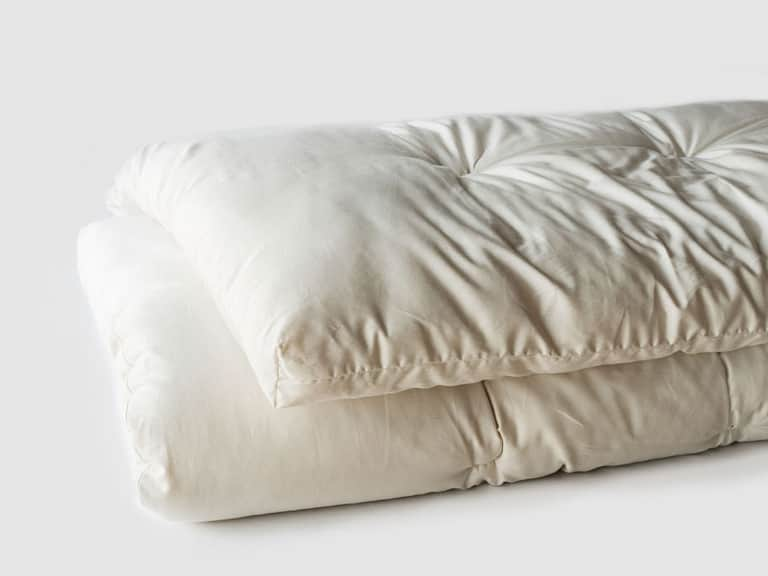
A comforter’s structure determines how the wool is held in place and how evenly the layer feels. Quilting can divide the surface into sections and help limit movement of the fill. Look at the pattern and description to understand how the filling is secured, and consider whether the stitching and compartments match the way you use the bed. A comforter used under a duvet cover may be handled differently from one used as the visible top layer.
The shell matters, too. Organic cotton sateen, cotton percale, and other cotton fabrics can differ in texture and finish. The cover is the material closest to the sleeper when no duvet cover is used, and it also affects how the comforter is cleaned. A separate duvet cover can protect the shell from routine dirt and reduce the frequency of laundering, though it adds another item to wash and dry.
Some products combine wool with other fibers. A washable wool-blend comforter, for example, may use wool alongside plant-based batting. In the available descriptions, one washable design is listed as 85% NATIVA wool and 15% plant-based batting, with an organic cotton sateen shell and corner loops for attaching a duvet cover. A blend may be selected to meet a particular construction or care goal, but its performance should be assessed from the specific product guidance rather than assumed from the word “wool.”
Brand names are only a starting point for research. Suite Sleep offers several wool comforter descriptions, including lightweight and washable options, with care directions that differ by model. Naturepedic’s alpaca duvet insert is a related natural-fiber bedding example rather than a conventional sheep-wool comforter: its listing describes an alpaca-wool fill and an organic cotton cover, with spot cleaning recommended. These examples illustrate why the exact fill, construction, and label matter more than relying on a brand or a broad material category.
Care needs: the detail that changes the decision
Care instructions vary widely. Some wool comforters are intended for spot cleaning and periodic airing, while selected washable models may be washed on a gentle or wool cycle. Others require a particular method, such as cold water, limited agitation, or air drying. A comforter that can be washed in one product line does not establish that every wool comforter is washable.
Read the sewn-in label and the product’s current care instructions before washing. If those directions differ from general advice, follow the manufacturer’s guidance. Wool can shrink, felt, clump, or lose its intended structure when exposed to unsuitable combinations of agitation, heat, or moisture. A large comforter also needs enough room to move through the washer and enough drying time for its full thickness to become dry.
For spot-clean or air-out designs, a removable duvet cover can be especially useful. It creates a washable layer between the sleeper and the comforter, helping reduce routine soil. Periodic airing, when permitted by the maker, can help refresh bedding. Avoid assuming that direct sun or high heat is appropriate for every product; follow the label, since materials and finishes vary.
Washable designs bring convenience, but they still have conditions. A model may require a front-loading washer, a gentle cycle, a specified detergent, or careful drying. Check whether the product can be tumble-dried, whether the dryer must be set to low heat, and whether the comforter needs to be removed before it is completely dry and finished flat. The instructions are part of the product’s design, not an optional footnote.
When evaluating care, ask yourself a few practical questions:
- Do you want to wash the entire comforter at home, or are spot cleaning and airing acceptable?
- Can your washer and dryer handle a bulky item safely?
- Do you have space to air-dry a comforter thoroughly?
- Will you use a duvet cover or a separate washable protector?
- Are you comfortable following wool-specific directions rather than using a standard bedding wash routine?
A sustainable choice is about more than fiber
Wool is a renewable animal fiber, but that fact alone does not describe the full environmental or ethical story of a comforter. Origin, animal-care practices, farming methods, processing, transport, shell materials, expected service life, and disposal all contribute to its wider footprint. Transparent product details make these factors easier to assess.
Certifications can help, but they have specific scopes. A label associated with organic textiles may apply to a particular material or stage of production; it should not be assumed to verify every part of a product’s supply chain. Check which component is certified, who issued the certification, and whether the claim applies to the wool, the cotton cover, or both. Where information is unclear, a precise question is more useful than a broad claim such as “eco-friendly.”
Durability and care are also relevant. A comforter that is protected, used appropriately, and maintained according to its instructions may remain in service longer than one that is repeatedly cleaned in unsuitable ways. Buying the weight that genuinely fits the room can also help avoid replacing an uncomfortable item soon after purchase. Sustainability is not a single feature; it is a series of choices across sourcing, use, upkeep, and eventual replacement.
A practical comparison checklist
Before choosing between two wool comforters, write down the details that matter most in your home. A short comparison can prevent a persuasive seasonal label or a long list of material claims from obscuring the useful information.
- Record the room conditions. Note whether the bedroom is usually warm, cool, or variable, and whether you use heating overnight.
- Describe your current comfort. Think about whether you tend to remove layers, add blankets, or prefer a substantial covering.
- Compare fill amounts. Look for a stated weight and unit. If the figures are not provided, treat that as missing information rather than guessing.
- Check the whole construction. Confirm the fill, any blend components, shell fabric, quilting, and dimensions.
- Read the care label before buying. Decide whether spot cleaning, airing, professional laundering, or machine washing suits your routine.
- Consider a cover and layering plan. A duvet cover or separate blanket may add useful flexibility, but also affects laundry and storage.
- Verify claims and certifications. Identify which materials are covered and seek clear sourcing information where it is available.
If product descriptions use different units, convert them only when the underlying measurements are clear. A fill amount per area cannot be compared directly with a total fill weight without considering comforter dimensions. When the information is incomplete, ask the maker for clarification rather than treating an approximate category as an exact specification.
Choosing with confidence
The best wool comforter is not necessarily the heaviest, the most highly certified, or the one labeled for the most seasons. It is the one whose warmth, construction, and maintenance fit the conditions of the room and the habits of the household. A lightweight design may make sense for a warm bedroom or a sleeper who prefers less coverage. A medium or heavier option may suit a cooler room, especially when the rest of the bed is kept simple. A washable model may be attractive to someone who prioritizes home laundering, provided its specific instructions are practical to follow.
Fill weight gives useful context, but it cannot tell the whole story. Consider the wool’s construction, the cover, the way the fill is secured, and the product’s actual care requirements. Compare like with like, question vague labels, and look for transparent details about materials and sourcing. The result is a calmer, more deliberate choice—one based on how you sleep and live, rather than on a season name alone.
Ultimately, a comforter becomes part of the nightly landscape: a familiar layer shaped by the climate beyond the window and the small routines inside the home. Choosing carefully means attending to both—the feel you want at bedtime and the care you can sustain long after the first night.